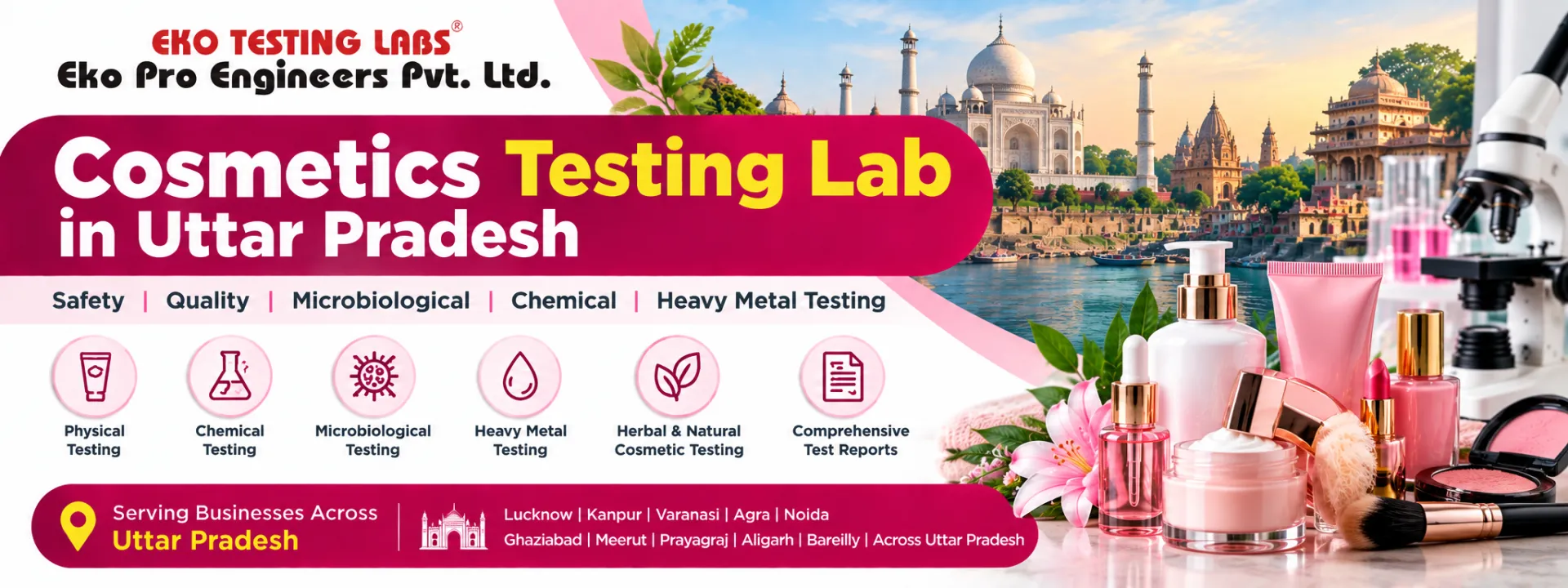
EKO Testing Lab provides Cosmetics Testing Services in Uttar Pradesh for cosmetic manufacturers, brands, importers, exporters, private-label companies, distributors and suppliers.
Cosmetics testing helps evaluate the quality, safety, microbiological condition, chemical composition, physical properties, stability and regulatory compliance of cosmetic products according to applicable Indian Standards, regulatory requirements, customer specifications and intended use.
Cosmetic products can include skincare, haircare, makeup, personal-care and other products applied to the human body. Because different formulations contain different ingredients and packaging systems, the appropriate test programme should be selected according to the product type, formulation, intended use and applicable requirement.
BIS currently lists IS 3958:2021 – Methods of Sampling Cosmetics, reviewed in 2026, and IS 4011:2018 – Methods of Test for Safety Evaluation of Cosmetics, also reviewed in 2026. BIS also lists IS 4707 Part 2:2025 – Classification of Cosmetic Raw Materials and Adjuncts: List of GNRAS and Restricted Ingredients, reviewed in 2026.
Cosmetics Testing Services in Uttar Pradesh
Cosmetics testing may involve physical, chemical, microbiological and safety evaluation depending on the formulation and intended application.
Testing can be relevant for:
- Face creams
- Moisturizers
- Lotions
- Sunscreens
- Face washes
- Cleansers
- Serums
- Gels
- Shampoos
- Conditioners
- Hair oils
- Hair creams
- Hair dyes
- Lipsticks
- Lip balms
- Foundation
- Face powders
- Skin powders
- Nail products
- Perfumes
- Deodorants
- After-shave products
- Oral-care cosmetic products
- Herbal cosmetics
- Ayurvedic-origin cosmetic formulations
- Baby-care cosmetic products
- Other personal-care formulations
The final test parameters depend on the formulation, ingredients, product category and applicable regulatory requirement.
Cosmetic Testing as per Indian Standards
Indian Standards cover sampling, safety evaluation, raw materials, restricted ingredients and product-specific specifications for cosmetics.
Important standards include:
- IS 3958:2021 – Methods of Sampling Cosmetics
- IS 4011:2018 – Methods of Test for Safety Evaluation of Cosmetics
- IS 4707 Part 1:2020 – Classification of Cosmetic Raw Materials and Adjuncts: Colourants
- IS 4707 Part 2:2025 – Classification of Cosmetic Raw Materials and Adjuncts: List of GNRAS and Restricted Ingredients
- Product-specific Indian Standards for various finished cosmetics
BIS’s cosmetics programme of work covers terminology, sampling and testing methods, raw materials and specifications for finished cosmetic products.
The applicable latest edition, amendments and regulatory requirements should be verified before testing.
Physical Testing of Cosmetics
Physical testing evaluates the basic characteristics of a cosmetic formulation.
Depending on the product, testing may include:
- Appearance
- Colour
- Odour
- Texture
- pH
- Viscosity
- Specific gravity
- Density
- Homogeneity
- Fill weight
- Spreadability
- Particle characteristics
- Separation
- Consistency
Physical testing can help manufacturers monitor batch-to-batch consistency and product specifications.
pH Testing of Cosmetics
pH is an important quality parameter for many water-based cosmetic products.
Testing may be relevant for:
- Face wash
- Shampoo
- Conditioner
- Cream
- Lotion
- Gel
- Liquid cleanser
- Hair products
- Other aqueous formulations
The appropriate pH range depends on the specific product formulation and applicable specification.
Viscosity Testing
Viscosity testing evaluates the flow behaviour of cosmetic formulations.
It can be relevant for:
- Creams
- Lotions
- Shampoos
- Conditioners
- Gels
- Serums
- Cleansers
- Liquid cosmetics
Viscosity can help manufacturers maintain consistency between production batches and monitor formulation changes.
Microbiological Testing of Cosmetics
Microbiological testing is an important part of safety evaluation for many cosmetic products, particularly water-containing formulations.
Testing may include:
- Total viable microbial count
- Total bacterial count
- Total yeast and mould count
- Specified microorganisms
- Pathogenic microorganisms
- Microbial contamination screening
BIS’s current standards database identifies IS 14648:2011 – Microbiological Examination of Cosmetics and Cosmetic Raw Materials – Methods of Test, reviewed in 2026.
The applicable microbiological test panel should be selected according to the product formulation and relevant requirement.
Microbial Limit Testing
Microbial-limit testing helps determine whether a cosmetic contains microbial contamination above the applicable specification.
This can be important for:
- Creams
- Lotions
- Shampoos
- Gels
- Liquid products
- Herbal cosmetics
- Baby-care products
- Water-based formulations
The acceptance criteria depend on the product category and applicable requirement.
Pathogen Testing in Cosmetics
Certain cosmetic products may require testing for specified microorganisms or pathogens.
Testing can help evaluate the microbiological safety of the formulation.
Potential target organisms depend on:
- Product type
- Intended use
- Formulation
- Regulatory requirement
- Applicable test method
The laboratory test programme should therefore be selected according to the specific cosmetic rather than applying the same pathogen panel to every product.
Preservative and Challenge Testing
Preservatives help protect susceptible cosmetic formulations from microbial growth.
Where required, preservative/challenge evaluation can help assess the effectiveness of a product’s preservation system under a defined test protocol.
It can be relevant to:
- Creams
- Lotions
- Shampoos
- Gels
- Liquid cosmetics
- Water-based products
The exact challenge-test method and acceptance criteria should be agreed according to the applicable standard or customer specification.
Heavy Metal Testing in Cosmetics
Heavy-metal testing may be relevant to cosmetic raw materials, pigments, colourants and finished products.
Depending on the applicable requirement, testing may involve specified elements such as:
- Lead
- Arsenic
- Mercury
- Cadmium
- Chromium
- Other specified metals
BIS currently lists IS 17495:2021 – Cosmetics: Analytical Approach for Screening and Quantification Methods for Heavy Metals in Cosmetics, reviewed in 2026.
The applicable elements and acceptance limits should be determined from the current product-specific or regulatory requirement.
Chemical Testing of Cosmetics
Chemical testing can help evaluate formulation composition and specified safety parameters.
Depending on the product, testing may include:
- Active ingredients
- Preservatives
- Colourants
- Restricted ingredients
- Heavy metals
- Chemical contaminants
- pH
- Residual substances
- Product-specific chemical parameters
The appropriate analytical panel should be selected based on the formulation and intended regulatory purpose.
Restricted Ingredients Testing
Cosmetic formulations may contain ingredients subject to restrictions or conditions of use.
BIS currently lists IS 4707 Part 2:2025, covering the classification of cosmetic raw materials and adjuncts, including the list of GNRAS and restricted ingredients. The standard was reviewed in 2026.
Testing and regulatory review may therefore be relevant for:
- Restricted preservatives
- Restricted colourants
- Certain hair-dye ingredients
- Restricted UV filters
- Other regulated cosmetic ingredients
The current applicable regulatory list should be checked before making a compliance conclusion.
Colourant Testing in Cosmetics
Colourants can be important ingredients in:
- Lipsticks
- Face powders
- Foundations
- Eye cosmetics
- Nail products
- Hair dyes
- Other coloured formulations
BIS maintains IS 4707 Part 1:2020 concerning classification of cosmetic raw materials and adjuncts, including colourants.
Testing can be selected according to the colourant, product category and applicable requirement.
Sunscreen Testing
Sunscreen products may require specialized testing depending on the claims and regulatory purpose.
Potential evaluations may include:
- Physical and chemical properties
- UV-filter-related parameters
- Active ingredient content
- Microbiological quality
- Stability
- Packaging compatibility
- Product-specific performance claims
Any SPF, UVA, water-resistance or other performance claim should be supported by the appropriate validated test method and should not be inferred solely from routine quality testing.
Herbal and Natural Cosmetics Testing
Herbal and plant-based cosmetics may contain multiple botanical ingredients.
Testing can include:
- Physical properties
- pH
- Microbiology
- Heavy metals
- Chemical contaminants
- Preservative effectiveness where applicable
- Active/botanical marker compounds where specified
- Adulteration or identity testing where relevant
- Stability
“Natural” or “herbal” does not automatically mean that a product is free from contamination or regulatory requirements.
Ayurvedic-Origin Cosmetic Product Testing
Products containing herbal or traditional ingredients may require testing based on their regulatory classification and intended claims.
Testing may include:
- Microbiological quality
- Heavy metals
- Physical parameters
- Chemical parameters
- Ingredient identity
- Contaminants
- Stability
- Product-specific quality parameters
The legal classification of a product should be established before selecting a regulatory testing programme.
Shampoo Testing
Shampoo testing may include:
- Appearance
- Colour
- Odour
- pH
- Viscosity
- Specific gravity
- Microbial limits
- Active ingredients where applicable
- Preservative-related parameters
- Stability
- Packaging compatibility
BIS’s cosmetics standards database includes IS 7884:2023 – Shampoo – Specification, reviewed in 2023.
The applicable current specification should be verified before testing.
Hair Oil Testing
Hair oils may require evaluation of:
- Appearance
- Colour
- Odour
- Specific gravity
- Refractive or other applicable physical properties
- Acid-related parameters where relevant
- Rancidity/oxidation-related parameters where applicable
- Microbiological quality where relevant
- Chemical composition
- Stability
BIS’s government-regulation reference page identifies hair oils among finished cosmetic standards historically referenced under the regulatory framework.
The current regulatory requirement should be confirmed for the specific product.
Skin Cream and Lotion Testing
Creams and lotions may require:
- Appearance
- Colour
- Odour
- pH
- Viscosity
- Homogeneity
- Microbiological quality
- Preservative/challenge testing where applicable
- Stability
- Heavy metals where required
- Restricted substances where applicable
The exact test panel depends on the formulation and product category.
Lipstick Testing
Lipsticks may require evaluation of:
- Appearance
- Colour
- Texture
- Melting/softening characteristics where applicable
- Microbiological quality
- Heavy metals
- Colourants
- Restricted ingredients
- Stability
- Packaging compatibility
BIS currently identifies IS 9875:2018 – Lipstick – Specification, reviewed in 2024, in its cosmetics standards information.
Face Powder and Skin Powder Testing
Powder cosmetics may require evaluation of:
- Appearance
- Particle characteristics
- Colour
- Odour
- Microbiological quality
- Heavy metals
- Colourants
- Restricted ingredients
- Packaging compatibility
BIS currently identifies product-specific standards including IS 3959:2023 – Skin Powder – Specification and IS 5339:2021 – Skin Powder for Infants in its cosmetics standards information.
Cosmetic Stability Testing
Stability testing helps evaluate how a cosmetic product behaves during storage.
Depending on the product, stability evaluation may monitor:
- Colour
- Odour
- Appearance
- pH
- Viscosity
- Phase separation
- Microbial quality
- Active ingredients
- Packaging interaction
- Container integrity
Stability conditions and duration should be selected according to the product, packaging, intended shelf life and applicable protocol.
Packaging Compatibility Testing
The cosmetic formulation and packaging must work together appropriately.
Packaging-compatibility evaluation may consider:
- Container interaction
- Leakage
- Discoloration
- Swelling
- Cracking
- Closure performance
- Pump performance
- Product absorption
- Chemical interaction
- Stability during storage
This can be particularly important for creams, serums, oils, perfumes and active formulations.
Cosmetic Raw Material Testing
Cosmetic manufacturers may also require testing of raw materials before production.
Possible raw materials include:
- Preservatives
- Colourants
- Fragrances
- Botanical extracts
- Oils
- Waxes
- Surfactants
- Emulsifiers
- Humectants
- Active ingredients
- Polymers
- Pigments
Testing can help verify identity, quality and selected safety parameters.
Cosmetic Testing for Manufacturers
Manufacturers can use laboratory testing during:
- Product development
- Raw-material qualification
- Pilot batches
- Production quality control
- Batch release
- Supplier qualification
- Stability studies
- Complaint investigation
- Regulatory documentation
Testing can help manufacturers identify formulation or production variations before products reach consumers.
Cosmetic Testing for Brands and Private Labels
Brands and private-label companies may use independent laboratory testing to evaluate products manufactured by third parties.
Testing can help assess:
- Product quality
- Formula consistency
- Microbiological quality
- Chemical safety
- Heavy metals
- Restricted ingredients
- Stability
- Packaging compatibility
- Customer specifications
Independent testing can support supplier qualification and quality-control systems.
Cosmetic Testing for Importers
Importers may require testing of cosmetic products sourced from overseas manufacturers.
Testing can help evaluate:
- Product identity
- Physical quality
- Microbiological quality
- Chemical parameters
- Heavy metals
- Restricted substances
- Product specifications
The applicable Indian regulatory requirements should be established before importation and market placement.
Cosmetic Testing for Exporters
Export cosmetic products may require testing against:
- Indian requirements
- Destination-country regulations
- Customer specifications
- Brand standards
- Restricted-substance lists
- International test methods
The destination market should be identified before finalizing the testing programme because requirements can vary significantly between markets.
Cosmetics Testing and Regulatory Compliance in India
Cosmetic compliance in India is broader than obtaining a laboratory test report. The product classification, manufacturing/import requirements, applicable standards, ingredient restrictions, labelling and other regulatory obligations should be assessed separately.
BIS’s published information shows that numerous Indian Standards for finished cosmetics have been referenced in India’s earlier regulatory framework, including standards for skin powders, toothpastes, skin creams, hair oils and shampoos.
For a specific product, the current applicable regulatory requirement should be checked rather than relying solely on an older standard list.
Cosmetic Safety Evaluation
Safety evaluation can include a combination of:
- Physical testing
- Chemical testing
- Microbiological testing
- Heavy-metal analysis
- Restricted-ingredient review
- Stability evaluation
- Packaging compatibility
- Product-specific safety parameters
BIS identifies IS 4011:2018 – Methods of Test for Safety Evaluation of Cosmetics, currently reviewed in 2026, as the relevant Indian Standard for cosmetic safety evaluation methods.
A laboratory test result should be interpreted within the scope of the specific test method and product requirement.
Cosmetics Testing Lab in Ghaziabad and Uttar Pradesh
EKO Testing Lab can support cosmetics-testing enquiries from manufacturers, brands, importers and suppliers across Uttar Pradesh and the Delhi NCR region.
Service enquiries may originate from:
- Ghaziabad
- Noida
- Greater Noida
- Lucknow
- Kanpur
- Agra
- Meerut
- Moradabad
- Aligarh
- Bareilly
- Varanasi
- Prayagraj
- Saharanpur
- Gorakhpur
- Other locations across Uttar Pradesh
This geographic coverage refers to testing enquiries and sample coordination and should not be interpreted as a claim of physical laboratory branches in every listed city.
Cosmetics Testing Process
1. Product Requirement Review
The cosmetic product type, formulation, intended use, packaging and regulatory objective are reviewed.
2. Standard and Requirement Identification
The applicable Indian Standard, regulatory requirement, customer specification or export-market requirement is identified.
3. Test Parameter Selection
Physical, chemical, microbiological and safety parameters are selected according to the product.
4. Sample Submission
Representative samples and relevant formulation/product information are submitted.
5. Laboratory Testing
The selected tests are performed using applicable laboratory procedures.
6. Test Report
Results are documented in the applicable laboratory report.
7. Compliance Evaluation
Where requested, results can be compared against the specified standard or requirement, subject to laboratory scope and the stated basis of evaluation.
Information Required for Cosmetics Testing
Manufacturers or brands should provide:
- Product name
- Product category
- Brand name
- Manufacturer details
- Batch number
- Manufacturing date
- Product formulation or ingredient information where required
- Intended use
- Target consumer group where relevant
- Product photographs
- Packaging details
- Applicable Indian Standard, if known
- Required test parameters
- Customer specification
- Destination country for export products
- Existing test reports, if available
Complete information helps identify the appropriate testing programme.
How to Choose a Cosmetics Testing Laboratory
Before selecting a laboratory, businesses should verify:
- Relevant cosmetics testing capability
- Current laboratory scope
- Microbiological testing capability
- Chemical testing capability
- Heavy-metal testing capability
- Required test methods
- Sampling requirements
- Reporting requirements
- Applicable Indian Standards
- Customer-specific requirements
For regulatory or certification-related testing, the laboratory’s current scope should be checked against the exact product and required parameters.
Why Choose EKO Testing Lab?
EKO Testing Lab provides testing support for cosmetic manufacturers, brands, importers, exporters and suppliers.
Cosmetic testing can be planned according to:
- Product category
- Formulation
- Intended use
- Ingredients
- Packaging
- Applicable Indian Standard
- Customer specification
- Regulatory requirement
- Export-market requirement
The final test programme remains subject to applicable laboratory scope, test-method availability and the specific cosmetic formulation.
Why Cosmetics Testing Is Important
Cosmetics testing can help businesses identify quality and safety concerns before commercial distribution.
A structured testing programme can help evaluate:
- Product consistency
- Microbiological quality
- Heavy metals
- Chemical parameters
- Restricted ingredients
- Physical properties
- Stability
- Packaging compatibility
- Product-specific safety requirements
Testing can support product development, quality control, supplier qualification, regulatory documentation and customer requirements.
Frequently Asked Questions
What is cosmetics testing?
Cosmetics testing is the laboratory evaluation of cosmetic products for physical, chemical, microbiological, safety and quality characteristics according to applicable standards, regulations or customer specifications.
Which Indian Standard covers sampling of cosmetics?
IS 3958:2021 – Methods of Sampling Cosmetics is the BIS standard for cosmetic sampling and was reaffirmed in January 2026.
Which Indian Standard covers safety evaluation of cosmetics?
IS 4011:2018 – Methods of Test for Safety Evaluation of Cosmetics is the relevant BIS standard and is shown as reviewed in 2026.
Can cosmetics be tested for heavy metals?
Yes. Heavy-metal testing can be performed where required. BIS currently lists IS 17495:2021, which provides an analytical approach for screening and quantification methods for heavy metals in cosmetics.
Can cosmetics be tested for microorganisms?
Yes. Microbiological examination can include microbial counts and specified microorganisms according to the applicable method and product requirements. BIS currently lists IS 14648:2011 for microbiological examination of cosmetics and cosmetic raw materials, reviewed in 2026.
Can shampoo be tested?
Yes. Shampoo can be evaluated for physical, chemical and microbiological parameters according to the applicable product specification and testing requirement.
Can cream and lotion be tested?
Yes. Creams and lotions can be tested for parameters such as appearance, pH, viscosity, microbiological quality, stability and other applicable safety or quality characteristics.
Can lipstick be tested?
Yes. Lipstick can be evaluated for applicable physical, chemical, microbiological, colourant and safety parameters.
Can herbal cosmetics be tested?
Yes. Herbal cosmetic products can be evaluated for physical, microbiological, chemical, heavy-metal and other applicable parameters based on their formulation and regulatory classification.
Can cosmetics be tested for restricted ingredients?
Testing or analytical verification may be performed for specified restricted ingredients where a suitable method and requirement are identified. BIS currently lists IS 4707 Part 2:2025 for restricted ingredients in cosmetic raw materials and adjuncts.
Can imported cosmetics be tested?
Yes. Imported cosmetic products can be tested against applicable Indian requirements, customer specifications or other identified requirements, subject to the relevant laboratory scope.
Can export cosmetics be tested?
Yes. Export cosmetics can be tested against customer, destination-market and applicable international requirements.
Does a cosmetics test report itself prove regulatory approval?
No. A laboratory test report addresses the specified tests performed on the submitted sample. Regulatory compliance may also involve product classification, ingredients, manufacturing/import requirements, labelling and other obligations.
How many samples are required for cosmetics testing?
The required quantity depends on the product, selected tests and test methods. Sample requirements should be confirmed before submission.
Can EKO Testing Lab support cosmetics testing across Uttar Pradesh?
Testing enquiries can be accepted from manufacturers, brands, importers and suppliers across Uttar Pradesh, including Ghaziabad, Noida, Greater Noida, Lucknow, Kanpur, Agra, Meerut, Moradabad and other locations, subject to sample logistics and applicable laboratory scope.
Request Cosmetics Testing in Uttar Pradesh
If you manufacture, import, distribute or market skin creams, lotions, shampoos, hair oils, face washes, serums, gels, sunscreens, lipsticks, powders, perfumes, herbal cosmetics or other personal-care products, EKO Testing Lab can help identify the relevant testing requirements.
Share your product category, formulation details, intended use, packaging information, applicable standard and required test parameters to determine the appropriate testing programme.
EKO Testing Lab provides cosmetics-testing support for manufacturers, brands, importers, exporters and suppliers seeking product quality, safety and compliance evaluation in Uttar Pradesh.