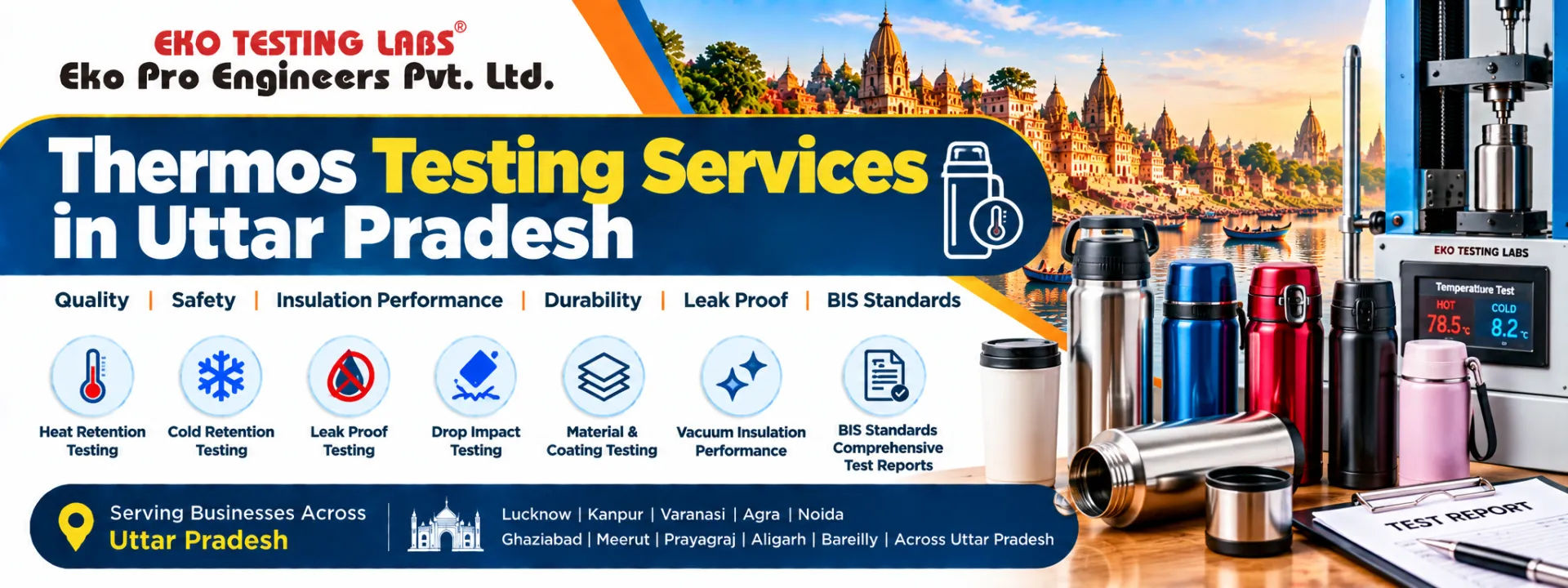
EKO Testing Lab provides Thermos Testing Services in Uttar Pradesh for manufacturers, brands, importers, exporters, distributors and suppliers of thermos flasks, insulated bottles and vacuum flasks. Testing can help evaluate product safety, thermal performance, leakage resistance, material quality, durability and conformity with applicable Indian Standards and regulatory requirements.
For domestic insulated stainless-steel flasks, IS 17790:2022 – Insulated Flask for Domestic Use — Specification addresses design, materials and functionality and includes tests such as capacity, heat-retention capability, impact resistance and leakage. The standard covers domestic insulated flasks used for maintaining hot and cold liquids for drinking purposes.
Where a product falls under a mandatory BIS certification requirement, laboratory testing and BIS certification should be treated as separate compliance steps. The applicable product standard, certification scheme and current laboratory scope should always be verified for the specific product.
Thermos Testing Services in Uttar Pradesh
Thermos testing may involve a combination of physical, mechanical, thermal, material and safety evaluations depending on the product design and intended use.
EKO Testing Lab can support testing requirements for products such as:
- Stainless steel thermos flasks
- Vacuum flasks
- Insulated water bottles
- Hot and cold beverage flasks
- Travel thermos bottles
- Double-wall insulated bottles
- Domestic insulated flasks
- Stainless steel vacuum bottles
- Thermos bottles with plastic outer bodies
- Thermos bottles with silicone seals and gaskets
- Drinking flasks and insulated beverage containers
- Promotional and private-label thermos products
Testing parameters are selected according to the product construction, intended use, applicable standard and required compliance objective.
Thermos Testing as per IS 17790:2022
IS 17790:2022 is an important Indian Standard for insulated flasks intended for domestic use. BIS describes these flasks as insulated storage vessels designed to maintain hot or cold contents for longer periods than the surrounding environment. The standard covers domestic insulated stainless-steel flasks and addresses construction, materials and functional performance.
Relevant testing can include:
- Capacity test
- Heat retention capability
- Impact resistance
- Leakage test
- Material-related requirements
- Construction and design-related requirements
- Safety and performance evaluation
The exact test programme should be determined from the applicable edition, product configuration and current compliance requirement.
Heat Retention Testing of Thermos
Heat retention is one of the most important performance characteristics of a thermos flask.
Testing can evaluate how effectively a thermos maintains the temperature of a hot liquid over a specified test period under controlled conditions.
Heat-retention testing can be relevant for:
- Stainless steel thermos
- Vacuum flask
- Insulated bottle
- Hot-water flask
- Beverage thermos
- Travel flask
Poor insulation, defective vacuum construction, unsuitable materials or inadequate sealing can negatively affect thermal performance.
Cold Retention Testing
Thermos products may also be designed to maintain the temperature of cold beverages.
Depending on the applicable method, testing may evaluate:
- Initial temperature
- Temperature change over time
- Insulation performance
- Thermal stability
- Product construction
- Performance of the vacuum or insulation layer
Cold-retention testing can be particularly relevant for insulated bottles marketed for beverages and outdoor use.
Thermos Leakage Testing
Leakage can affect product safety, usability and consumer acceptance.
Leakage testing may evaluate the complete assembled product, including:
- Bottle body
- Cap
- Lid
- Threaded closure
- Silicone gasket
- Sealing ring
- Valve or drinking mechanism
- Locking mechanism
Testing conditions should be selected according to the applicable product standard or customer specification.
Thermos Capacity Testing
Actual capacity is an important product specification.
Capacity testing may help verify whether the thermos contains the quantity declared on the product packaging or technical specification.
Capacity evaluation can be useful for:
- 250 ml thermos
- 500 ml thermos
- 750 ml thermos
- 1 litre thermos
- 1.5 litre thermos
- 2 litre thermos
- Other specified capacities
The applicable test method and tolerance should be established according to the relevant standard.
Impact Resistance Testing
A thermos may be exposed to accidental drops or impacts during normal handling, transportation and use.
Impact testing may evaluate the ability of the product to withstand specified impact conditions without unacceptable damage or loss of required functionality.
Possible evaluation areas include:
- Outer body
- Inner flask
- Cap
- Lid
- Base
- Handle
- Structural components
- Leakage after impact
- Functional performance after impact
For products covered by IS 17790:2022, impact resistance is among the specified performance tests.
Stainless Steel Thermos Testing
Stainless steel is widely used for the inner and outer construction of insulated flasks.
Testing requirements may include evaluation of:
- Material grade
- Construction
- Thickness
- Corrosion-related characteristics where applicable
- Food-contact suitability
- Surface condition
- Leakage
- Thermal performance
- Mechanical durability
The exact material requirements should be checked against the applicable product standard and product configuration.
Plastic Component Testing
Thermos products may contain plastic components such as:
- Outer body
- Lid
- Cap
- Handle
- Drinking spout
- Closure components
- Internal components
Where plastic components are intended for food contact, applicable food-contact requirements should be considered.
FSSAI’s packaging framework requires materials that directly contact food or are likely to come into contact with food to be of food-grade quality and suitable for their intended use.
BPA Testing for Thermos Products
BPA-related testing may be relevant where thermos products contain polycarbonate or other materials for which BPA requirements apply.
The applicable requirement depends on:
- Material composition
- Intended use
- Food-contact application
- Current regulatory requirements
- Applicable Indian Standard
- Product construction
It is important to distinguish a test result for a particular material/component from a general claim that an entire product is “BPA-free.”
Food-Contact Material Testing
For thermos products intended to store drinking water, beverages or other food products, food-contact safety can be an important part of the compliance assessment.
Testing may include, where applicable:
- Overall migration
- Specific migration
- Material composition
- Heavy metals
- Restricted substances
- Sensory or organoleptic evaluation
- Chemical safety parameters
- Food-contact suitability
FSSAI’s current published packaging framework states that food-contact materials must be food grade and compatible with their intended use, while packaging materials must withstand relevant mechanical, chemical and thermal stresses.
FSSAI maintains the Packaging Regulations and amendments on its official website; the current listed amendments include those dated 27 January 2022, 30 August 2022 and 28 March 2025.
Silicone Gasket and Seal Testing
Silicone gaskets and sealing rings are critical components of many thermos products.
Testing may evaluate:
- Gasket material
- Physical condition
- Sealing performance
- Leakage resistance
- Food-contact suitability
- Migration requirements where applicable
- Compatibility with intended use
- Durability under specified conditions
The appropriate testing method depends on the gasket material, product design and applicable requirement.
Lid and Closure Testing
A thermos lid should provide effective sealing while remaining practical for repeated use.
Testing may consider:
- Lid fit
- Thread engagement
- Closure strength
- Leakage
- Seal integrity
- Opening and closing performance
- Locking mechanism
- Drinking mechanism
- Gasket placement
- Compatibility with the bottle body
Vacuum and Insulation Performance
The thermal performance of a thermos is strongly influenced by its insulation system.
Testing may help evaluate:
- Heat transfer performance
- Heat retention
- Cold retention
- Vacuum insulation performance
- Double-wall construction
- Insulation material
- Thermal stability
Where a vacuum-insulated construction is used, testing can help identify performance differences between properly manufactured and defective units.
Thermos Safety and Quality Testing
A comprehensive testing programme may address multiple product characteristics rather than relying on a single test.
Depending on the product, this can include:
- Capacity
- Heat retention
- Cold retention
- Leakage
- Impact resistance
- Material verification
- Food-contact requirements
- Surface condition
- Workmanship
- Closure performance
- Seal performance
- Thermal performance
- Dimensional characteristics
The final test parameters should be selected based on the applicable standard and the intended product claim.
Thermos Bottle Testing for Manufacturers
Manufacturers can use laboratory testing to evaluate product quality before commercial production and during quality-control programmes.
Testing can help manufacturers:
- Verify product specifications
- Identify manufacturing defects
- Evaluate new designs
- Compare materials
- Check supplier components
- Investigate leakage complaints
- Evaluate thermal performance
- Support product documentation
- Prepare technical compliance records
Testing should be integrated with the manufacturer’s quality-control process rather than treated only as a final inspection activity.
Thermos Testing for Importers and Brands
Importers and private-label brands may require independent testing before placing thermos products in the Indian market.
Testing can help assess:
- Product specifications
- Material safety
- Thermal performance
- Leakage
- Mechanical durability
- Food-contact requirements
- Supplier consistency
- Applicable Indian Standards
For imported products, the required documentation and applicable regulatory route should be determined according to the product category and current Indian requirements.
Thermos Testing for Exporters
Export-oriented thermos manufacturers may require testing against Indian or destination-market requirements.
Depending on the destination, testing may involve:
- Product safety
- Food-contact requirements
- Chemical restrictions
- Material requirements
- Thermal performance
- Mechanical performance
- Customer-specific specifications
Export requirements vary by country and buyer, so the destination-market requirement should be identified before selecting the final test package.
Why Thermos Testing Is Important
Thermos testing helps businesses evaluate whether a product performs as intended and whether its materials and construction are suitable for its intended application.
A properly designed testing programme can help identify:
- Excessive heat loss
- Poor cold retention
- Leakage
- Weak closures
- Material-related concerns
- Manufacturing defects
- Poor impact resistance
- Incorrect capacity
- Inadequate sealing
- Food-contact compliance issues
Testing can therefore support product development, quality assurance, supplier qualification and regulatory documentation.
BIS Compliance for Thermos and Insulated Flasks
BIS has a compulsory certification framework covering certain insulated flasks, bottles and containers for domestic use. BIS’s current product-certification information lists IS 17790:2022, along with related standards including IS 17526:2021 Domestic Stainless Steel Vacuum Flask/Bottle and IS 17569:2021 Insulated Container for Food Storage under the relevant product-certification framework.
Therefore, manufacturers and importers should identify the exact product category and applicable standard before deciding which tests are required.
A laboratory test report should not automatically be represented as a BIS licence or ISI certification. BIS certification is a separate regulatory process.
Thermos Testing Lab in Ghaziabad and Delhi NCR
EKO Testing Lab can serve businesses looking for thermos and insulated-product testing support in the Uttar Pradesh and Delhi NCR region.
The service can be relevant for businesses operating in or supplying from:
- Ghaziabad
- Noida
- Greater Noida
- Lucknow
- Kanpur
- Agra
- Meerut
- Moradabad
- Aligarh
- Bareilly
- Varanasi
- Prayagraj
- Saharanpur
- Gorakhpur
- Other locations across Uttar Pradesh
This geographic coverage refers to service enquiries and sample/testing coordination and should not be interpreted as a claim of physical laboratory branches in every listed city.
Thermos Testing Process
The typical testing process can include:
1. Product Requirement Review
The product type, construction, capacity, material and intended use are reviewed.
2. Applicable Standard Identification
The relevant Indian Standard, regulatory requirement, customer specification or destination-market requirement is identified.
3. Test Parameter Selection
The required tests are selected according to the product and applicable scope.
4. Sample Submission
Representative product samples and relevant product information are submitted for testing.
5. Laboratory Testing
The selected tests are performed using applicable methods and laboratory procedures.
6. Test Report
Results are documented in the applicable laboratory test report format.
7. Compliance Interpretation
Where requested, results can be reviewed against the applicable specification or test requirement, subject to the laboratory’s scope and the stated basis of evaluation.
Information Required for Thermos Testing
Before submitting a thermos sample, manufacturers or brands should provide relevant information such as:
- Product name
- Product model or code
- Manufacturer details
- Capacity
- Material details
- Intended use
- Product photographs
- Technical specifications
- Applicable Indian Standard, if known
- Required test parameters
- Customer specification, if applicable
- Destination country for export products
- Existing test reports, if available
Providing complete product information can help determine the appropriate testing programme.
How to Choose a Thermos Testing Laboratory
When selecting a laboratory, businesses should consider:
- Whether the required test methods are available
- Applicable laboratory scope
- Relevant Indian Standards
- Testing capability for the product type
- Sample requirements
- Reporting requirements
- Regulatory purpose of the test
- Whether the report is required for BIS or another compliance process
- Whether the laboratory’s current scope covers the requested test
For regulated products, the laboratory’s current scope and applicable certification requirements should be verified before testing.
Why Choose EKO Testing Lab?
EKO Testing Lab focuses on product testing and analytical testing requirements for manufacturers, brands, importers and suppliers.
For thermos products, testing can be planned around the actual product construction and intended use rather than applying an identical test package to every product.
Testing requirements remain subject to applicable standards, laboratory scope, test method availability and the intended compliance purpose.
Request Thermos Testing in Uttar Pradesh
If you manufacture, import, distribute or market thermos flasks, vacuum bottles or insulated drinking containers, EKO Testing Lab can help you identify the relevant testing requirements and prepare an appropriate testing plan.
Share your product details, capacity, material specification, photographs and required compliance standard to discuss the applicable test parameters.
Frequently Asked Questions
What is thermos testing?
Thermos testing is the laboratory evaluation of an insulated flask or bottle for characteristics such as capacity, heat retention, leakage, impact resistance, materials and other applicable safety or performance parameters.
Which standard is used for domestic insulated flasks in India?
IS 17790:2022 is the Indian Standard titled “Insulated Flask for Domestic Use — Specification.” It addresses domestic insulated flasks and includes tests such as capacity, heat retention, impact resistance and leakage.
Is BIS certification required for thermos products?
Certain insulated flasks, bottles and containers are covered under India’s BIS compulsory certification framework. The applicable requirement depends on the exact product category and relevant standard, so the current BIS requirement should be verified before placing the product on the market.
Does thermos testing include heat retention?
Yes. Heat retention is an important performance characteristic for insulated flasks and is specifically included among the tests described for IS 17790:2022.
Can thermos bottles be tested for leakage?
Yes. Leakage testing can be performed according to the applicable standard or specified test method.
Is BPA testing required for thermos bottles?
BPA testing may be relevant when the product contains applicable plastic materials or components. The requirement should be determined from the material, intended food-contact use and current applicable regulations or standards.
Can stainless steel thermos bottles be tested?
Yes. Stainless steel thermos products can be evaluated for applicable material, construction, thermal, leakage, impact and food-contact requirements.
Can imported thermos bottles be tested?
Yes. Importers can obtain product testing against applicable Indian Standards, regulatory requirements or customer specifications, subject to the required laboratory scope.
Does a laboratory test report provide BIS certification?
No. A laboratory test report and BIS certification are separate compliance documents. Where BIS certification is mandatory, the applicable BIS certification process must be followed.
How many samples are required for thermos testing?
Sample requirements depend on the applicable standard, test programme and laboratory method. The required quantity should be confirmed before sample submission.
Can EKO Testing Lab test thermos products from across Uttar Pradesh?
Testing enquiries can be handled for manufacturers, brands, importers and suppliers across Uttar Pradesh, including businesses in Ghaziabad, Noida, Greater Noida, Lucknow, Kanpur, Agra, Meerut and other locations, subject to sample logistics and applicable laboratory scope.
Thermos Testing Lab in Uttar Pradesh – EKO Testing Lab
For reliable product evaluation, manufacturers and brands should select testing parameters according to the actual thermos construction, intended use and applicable Indian Standard.
EKO Testing Lab can assist with identifying the relevant testing requirements for thermos flasks, vacuum bottles and insulated containers, subject to applicable laboratory scope and test-method availability.
Contact EKO Testing Lab with your product specification and testing requirement to determine the appropriate testing programme.